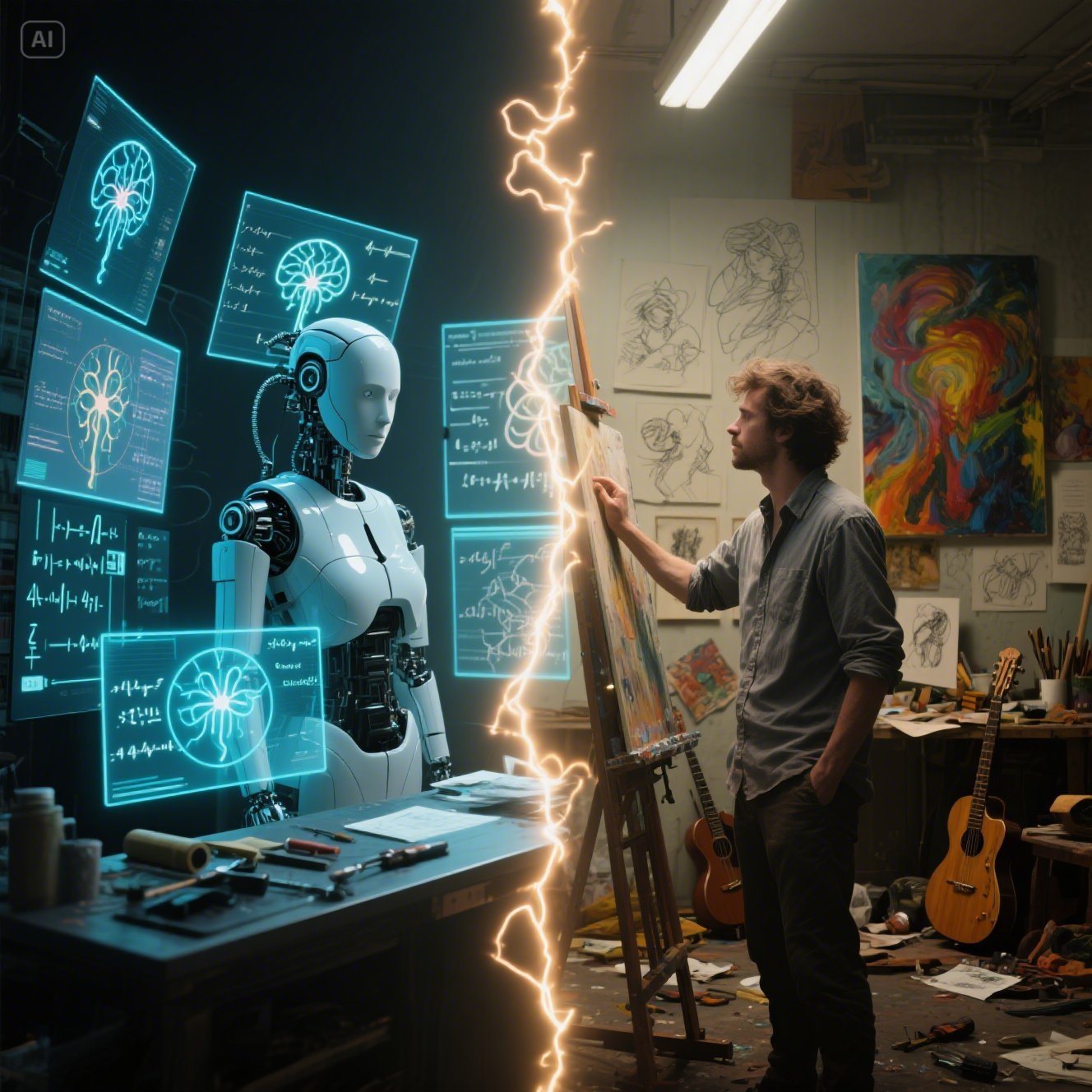
The debate between AI and human creativity centers on what each brings to the creative process. While AI can generate ideas quickly and recognize patterns with impressive efficiency, it lacks the emotional depth and contextual understanding that define human creativity.
The most valuable answer to whether AI has surpassed human creativity is that AI enhances but does not replace human imagination and originality. This collaboration allows for new forms of innovation that neither could achieve alone.
As AI tools become more integrated into creative fields, they empower humans to work faster and smarter. The future of creativity lies in how humans leverage AI’s strengths without losing the uniquely human ability to connect emotions and experiences to artistic expression.
Defining AI and Human Creativity
Creativity in AI and humans involves distinct mechanisms and outcomes. AI relies on data-driven processes and algorithmic patterns, while human creativity is anchored in emotional depth and contextual awareness. Understanding these differences clarifies how each type functions.
What Is AI Creativity?
AI creativity involves generating novel outputs using algorithms and large datasets. It processes information quickly and identifies patterns that humans might miss. This form of creativity excels in tasks like design, music composition, and text generation through learned data models.
AI systems do not experience emotions or consciousness. Instead, they rely on programmed objectives and statistical correlations. Their creative output is often a synthesis or variation of existing information rather than originating from intrinsic experience or intuition.
AI’s efficiency allows it to automate routine creative tasks, enhancing productivity. However, AI creativity is bounded by the quality and scope of its training data, limiting its ability to independently innovate beyond learned patterns.
What Is Human Creativity?
Human creativity stems from cognitive processes intertwined with emotions, experiences, and cultural context. It encompasses imagination, intuition, and the ability to generate original ideas inspired by subjective understanding.
Humans evaluate their creative work based on emotional resonance and social impact. This reflective capability allows for continuous refinement and deeper meaning in artistic expression.
The human creative process often involves unpredictable insights and abstract thinking. It can break established patterns by drawing on personal and collective memories, emotions, and values, making the output uniquely original.
Core Differences in Creative Processes
Aspect AI Creativity Human Creativity Source Data-driven algorithms, patterns Emotional depth, experiences, intuition Speed Rapid computation and generation Variable, involves reflection and iteration Novelty Combination of existing data Original ideas, often unpredictable Emotional Context None Integral part of creation Adaptability Limited to training data scope Can adapt and innovate beyond prior knowledge
AI creativity thrives on efficiency, pattern recognition, and automation. Human creativity thrives on emotional context, originality, and contextual understanding. Both processes can complement each other but operate on fundamentally different principles.
Strengths of AI in Creative Fields
AI offers unique capabilities that differentiate it from human creators. Its ability to quickly process vast amounts of information and generate multiple outputs is unmatched. Additionally, AI’s reliance on extensive data allows it to draw from a wide range of sources, supporting novel combinations and ideas. It also plays an important role in helping creators bypass creative hurdles.
Speed and Scalability
AI can produce creative content at a scale and speed beyond human capacity. Tools like image generators and text models deliver hundreds or thousands of variations within minutes. This acceleration benefits industries with tight deadlines or large content demands, such as advertising and media.
Because AI operates continuously without fatigue, it enables rapid iteration. This allows creators to review and select the best output much faster than traditional methods. Efficiency gains are critical when managing high-volume projects or responding swiftly to market trends.
Data-Driven Inspiration
AI’s strength lies in synthesizing information from extensive datasets. It learns patterns from existing creative work—images, music, writing—and recombines elements in ways humans might not consider. This capability provides a diverse palette of styles and concepts.
By leveraging data, AI can generate outputs conditioned on specific parameters like color schemes, themes, or moods. This makes AI useful for tasks requiring consistent brand aesthetics or tailored creative directions.
Overcoming Creative Blocks
AI acts as a tool to break through creative stagnation. When a human creator is stuck, AI can suggest fresh ideas or variations to revive the process. This external input can trigger new perspectives and spark innovation.
Because AI generates ideas without emotional bias or fatigue, it can offer unconventional solutions that challenge habitual thinking. This collaborative dynamic between AI and humans extends creative potential rather than replacing human insight.
Strengths of Human Creativity
Human creativity is marked by a unique combination of emotional insight, intuitive reasoning, and deep cultural understanding. These aspects enable humans to produce work that resonates on a personal level, adapts fluidly to context, and reflects complex social realities.
Emotional Depth and Empathy
Humans possess the ability to infuse their creative work with genuine emotional experience. This emotional depth allows artists, writers, and creators to connect with audiences by evoking feelings such as joy, sorrow, or empathy.
Empathy plays a critical role in understanding the perspectives of others, enriching storytelling and artistic expression. It drives humans to create work that reflects shared human experiences, making their creativity relatable and impactful.
Unlike AI, which processes data mechanically, human creators draw on personal memories and emotions, giving their output a distinct emotional texture and authenticity.
Intuitive Thinking
Humans often rely on intuition to solve problems and generate ideas without explicit reasoning. This type of thinking allows for leaps of insight that do not follow direct logical patterns but emerge from subconscious integration of experiences.
Intuition helps in recognizing novel connections between unrelated concepts, fostering originality. It supports creative decisions when information is incomplete or ambiguous, something AI struggles with.
This non-linear cognitive ability enables humans to innovate beyond known parameters and imagine possibilities that are not immediately evident.
Cultural and Contextual Awareness
Human creativity is deeply embedded in awareness of cultural norms, history, and social dynamics. Creators can interpret symbols, language nuances, and traditions in ways that resonate within specific communities.
They can adapt their work to align with or challenge prevailing cultural values, reflecting societal shifts and generating relevant commentary. This contextual sensitivity gives human creativity layers of meaning that AI cannot fully replicate.
Humans understand how context shapes reception, enabling them to tailor creative output that engages audiences effectively within diverse environments.
Collaboration Between AI and Humans
Combining AI with human creativity leverages the strengths of both. AI contributes speed, pattern recognition, and handling routine tasks, while humans provide emotional insight, critical judgment, and originality. This partnership shapes creative processes in significant and practical ways.
Human-AI Co-Creation
Human-AI co-creation involves interactive collaboration where AI tools generate ideas, drafts, or variations that humans then refine. AI systems serve as partners rather than mere tools, enabling creators to explore numerous possibilities quickly.
This dynamic expands creative potential by offering novel suggestions and alternative solutions that may not occur to humans alone. For example, in writing or design, AI can produce multiple concept iterations, allowing humans to select and build upon the best options.
The cooperative process relies on continuous feedback between human input and AI output. This strengthens creative decisions while maintaining human agency and control over the final product.
Workflow Augmentation
AI enhances traditional creative workflows by automating repetitive or time-consuming tasks. These include data analysis, formatting, or generating baseline content, which frees human creators to focus on higher-level conceptual work.
By handling routine operations efficiently, AI enables faster project completion without sacrificing quality. For instance, in graphic design, AI tools can automate color corrections or layout adjustments, allowing designers to concentrate on innovation.
This augmentation improves productivity without replacing human judgment. It streamlines processes and reduces manual effort, resulting in better use of human creative skills.
Hybrid Creative Projects
Hybrid projects combine human and AI contributions in balanced ways across various fields like art, music, and product design. AI often handles technical or experimental elements, while humans provide context, emotion, and narrative structure.
Examples include AI-generated music that musicians refine or AI-assisted architectural models shaped by human expertise. These projects demonstrate how AI complements human creativity rather than competing with it.
The variety of roles AI can perform—from assistant to co-creator—adapts to the specific needs of each creative domain. This flexibility supports diverse forms of collaboration tailored to project goals.
Challenges and Limitations
AI faces specific technical and ethical constraints that impact its creative potential. These include inherent boundaries in AI’s abilities, concerns around the ethical use of AI-generated content, and the influence of bias in its outputs. Each creates distinct hurdles for AI’s role in creative fields.
AI’s Creative Boundaries
AI systems generate ideas based on patterns in existing data rather than original thought. They lack genuine intuition, emotional understanding, and subjective experience, which limits their capacity for true innovation. While AI can combine and remix concepts efficiently, it struggles with producing work that reflects authentic human insight or emotional depth.
AI creativity often depends on the quality and diversity of its training data. When exposed to narrow or repetitive inputs, it tends to generate similar, unoriginal outputs. This repetition reduces novelty and can stifle innovation, especially in fields that value unique perspectives.
Ethical Concerns
Ethical issues arise around authorship, transparency, and misuse of AI-created content. Questions persist about who owns work generated by AI and how to credit contributions appropriately. Misrepresentation of AI output as purely human-made can mislead audiences and complicate trust.
There is also concern over the potential for AI to be exploited to create misleading or harmful material, such as deepfakes or plagiarized content. These risks highlight the need for clear guidelines and responsible use to prevent ethical violations in creative industries.
Bias in Creative Outputs
AI inherits biases from the datasets it learns from, which can perpetuate stereotypes or exclude minority perspectives. These biases affect the fairness and inclusivity of creative outputs, sometimes reinforcing harmful or outdated views.
Because AI relies on statistical correlations, it may amplify majority trends while marginalizing less represented voices. This can limit the diversity of creative expression and undermine efforts toward equity in art, media, and design. Addressing bias requires ongoing efforts to improve data quality and algorithmic fairness.
Future of Creativity: AI vs Human Impact
The interplay between AI and human creativity is reshaping how work and creative processes function. This influence extends to industries, the evolving nature of creativity, and the emergence of new artistic formats. Each area highlights distinct shifts driven by AI’s integration alongside human input.
Shaping Industries and Jobs
AI is transforming creative industries by automating routine tasks and enhancing productivity. In fields like design, advertising, and media, AI tools generate ideas, produce content, and optimize workflows. This shift requires creative professionals to adapt by focusing more on strategic and conceptual roles.
Job roles are evolving rather than disappearing. Organizations increasingly seek AI developers and specialists who can build systems complementary to human creativity. Collaboration between humans and machines is becoming essential, with AI handling data-driven or repetitive work while humans provide judgment, emotion, and nuanced insight.
Evolving Definitions of Creativity
The traditional notion of creativity as exclusively human is being challenged. AI systems now generate art, music, and writing, blurring the lines between mimicry and originality. Creativity is no longer limited to spontaneous inspiration but includes algorithmically supported innovation.
New frameworks emphasize creativity as a collaborative process involving both machines and humans. Ethical standards and responsible innovation are emerging as necessary to ensure AI enhances rather than detracts from genuine creative expression. This evolving definition recognizes AI’s role as a tool that expands creative potential rather than replacing human ingenuity.
Potential for New Art Forms
The fusion of AI and human creativity is generating novel art forms that were previously impossible. AI can explore vast design possibilities, create adaptive music, and develop immersive experiences tailored to individual viewers or listeners.
This capability opens opportunities for innovation across digital art, interactive media, and performance. Artists leverage AI not just as a tool but as a co-creator, pushing boundaries in aesthetics and expression. The result is a growing landscape of hybrid works that combine algorithmic complexity with human emotion and context.
Conclusion
AI and human creativity possess distinct but complementary strengths. AI excels at processing large data sets, generating ideas quickly, and automating routine creative tasks.
Humans contribute emotional depth, personal experience, and contextual understanding that AI currently cannot replicate fully. This emotional and cultural input remains a core part of creative expression.
The most productive path involves collaboration. AI can augment human creativity by handling repetitive elements and suggesting novel combinations, leaving humans to focus on originality and meaning.
Key points to consider:
- AI Strengths: Speed, pattern recognition, data-driven insights
- Human Strengths: Emotional nuance, cultural context, imaginative leaps
- Collaboration: AI tools enhance rather than replace human creativity
Future creative landscapes will evolve through this partnership. Creative professions may shift roles to integrate AI more deeply, redefining traditional creative processes.
Ultimately, creativity is not a zero-sum game between man and machine. Instead, it is an expanding field where both contribute in ways neither can achieve alone.
Discover more from AIWiredDaily
Subscribe to get the latest posts sent to your email.